Happy new year codets. Sorry i have been MIA--i was on vacation. Yes, I actually was. Went home to Seattle to visit my family for the entire month of December. Took my dog, Sybil, along with me. Why didn't i post? I spent the greater part of one month playing with my baby niece, sweating at kickboxing classes and lounging about on the couch while watching all six seasons of Doc Martin. But alas, the fun and games are over with. Back to work. Not that making cakes isn't fun--it is. Well, for me at least. I'm usually a bit blue after a trip to the US. Mostly due to the fact that it marks the end of the holidays, i won't see my family for some time, and honestly and truly i miss the Pacific Northwest. Luckily this time i had a distraction the moment I landed in Sao Paulo--I had a cake to make that night. No time to be blue. This cake is a four layer gluten free carrot cake (no nuts or raisins, just carrot and spices) with three layers of brown sugar buttercream, three layers of cream cheese frosting with peach colored roses on top. I was informed by my client that most of the party goers, trying to keep to their New Year regime, all asked for half a slice to "share" with their partner. She also informed me that the half soon turned into a whole and the sharing concept was chucked out the window. Success.
I thought i would take a moment for the travelers out there who read this blog (are there any of you?) to mention how traveling internationally with a dog went. When i told friends and family that i would be taking Sybil with me on my vacation to the US I received a lot of shocked looks--most people can perceive traveling with a dog when you move to a new country, but not just for a vacation. I mean, i didn't have to take her. I could have sent her to a dog hotel. The total cost of her trip was probably the same as a hotel anyway. But, as a former street and shelter dog, i didn't want to put her through the thought that we abandoned her to a new shelter. So elected to go the hard route and take her along for the ride. It's stressful no matter what country you are flying into or out of. Vets have to be visited, paperwork signed and appointments made. That in itself is the most stressful part. The actual travel itself is variable. Flying from Brazil to the US with the pup required a visit to the vet to obtain a health certificate and an appointment at the Brazilian Ministry of Agriculture within three days of departure. The ministry processes the paperwork for free. How nice of them. On the return, i had to do the same thing. Go to the vet, obtain a certificate of health and make an appointment with the USDA. The vet visit was twice the price in the US and there was a 38 dollar processing fee with the USDA. Not so bad.
I chose to fly Delta because they had a good pet policy and only charged 75 dollars each way for the pet to ride in the cabin. Even though the rules state that a dog or cat must stay in their carrier under the seat for the duration of the flight, i took Sybil out of her box on held her on my lap under a blanket during the flight from Sao Paulo to Detroit. None of the flight attendants cared or asked me to put her away. The same thing happened on my flight from Detroit to Seattle. No problem. She was silent, still and scared out of her mind. Customs in the US was practically non existent. They didn't even ask me to take her out of the box, and they handed me back the difficult to obtain paperwork after superficially glancing at it. Unfortunately my cabin crew on my return flights were not as keen on rule bending. My Seattle to New York flight went well until after an hour the first class attendant walked by and told me to put her box under the seat. Things got worse for poor Sybil on the flight from New York to Sao Paulo when the flight attendant told me that she must stay in the box under the seat for the full trip. About 12 hours total without getting out. I felt cruel for doing it, but i passed her food and water through the carrier. And she made it. In the end it really depends on the cabin crew. And a crowded 767 with screaming babies does not make for a cheery crew. I definitely recommend traveling with your pet if you are going for a significant period of time. Despite the stress of traveling, i know she had more fun passing her vacation in a big house with a big yard and cousin dogs to play with than scared in a dog hotel. And there you have it.
While i had planned on being part of an Easter celebration this year with eggs, chocolates and bunnies, a sort of last minute vacation got in the way. Thank god. Two weeks before the long four day weekend of Tiradentes (a holiday that celebrates a national revolutionary hero, Tiradentes, who was among the first martyrs for the cause of Brazilian independence from Portugal) that happened to fall the day before Good Friday, H and i decided to go to the beach. If you know anything about the state of São Paulo then you know that is a suicide mission. National holiday weekends on the São Paulo seashore are nightmares. Every human with the means to leave the concrete jungle will. not to mention the rest of us in the interior...so heading to the seashore with half a million cars. Brilliant! Somehow we managed to plan the trip strategically though; we left a day before the holiday started and chose a destination that while popular, is not among the destinations of the majority. Ilhabela is an Island just south of the São Paulo coast (you can see it clearly from the city of São Sebastião) and requires a ride on a small flat deck ferry to access. The long drive, ferry and extremely inflated prices of lodging, food and virtually everything on the island does not attract as many people as say the bigger and more affordable destinations such as Santos or Praia Grande. So while there were many visitors to the island during the weekend, it was nothing like Copacabana. Only a few of the island's beaches were crowded beyond our liking (we could never, ever be a carioca when the beaches turn into sheep farms.) While we did wake up at 2:30 on Sunday morning to avoid the five hour ferry wait and seven hour traffic crawl on the continet, the vacation was a wonderful decision and i didn't miss Easter at all. I can say that i have been to paradise, can you?
I really didn't take many photos while on vacation, there's something about just wanting to sit in your plastic yellow Skol chair and not do anything. at all. Well, anything other than drinking caipirinhas, rubbing on bug repellent (Ilhabela is known as mosquito Isle, and i'm still itching) and randomly getting up to jump in the deliciously blue water for a swim. We explored the island, sized up the beaches, trecked through a monkey trail for an hour to get to a hidden waterfall for an icy (dangerously slippery) swim, but in the end there was only one beach where we really wanted be--Praia do Jabaquara. The first day on the island i grabbed a map and decided that i wanted to go to Jabaquara only because it was the very last beach on the circuit that you can get to by car. All of the beaches on the eastern side of the island are only accessible by boat or by a guided jeep offroading expedition. So we drove, and drove and drove. It really is the last destination on the circuit. The drive is about an hour of long and ends on a bumpy, dangerous, dusty rock-filled dirt road that hugs the cliff on the northern side of the island. You really feel like you are never going to get there...witnessed a few cars giving up and turning around...if you are brave enough to scale the monkey trail then you end up at paradise. The beach is secluded, away from cars, roads, everything. And the distance and terrifying drive keeps the number of beach goers way down. White sand, a bar, trees, chairs and open ocean. The chairs and umbrellas belong to the only restaurant/bar on the beach, so if you sit you have to order. But it's well worth it, not just for the shade and seats but for the bathroom and shower. Buy a few drinks but bring a few of your own as well.
We liked Jabaquara so much that on the fourth day we gave up looking for another beach and just headed back with fresh fruit and a bottle of wine in tow. We did end up losing our licence plate on the difficult terrain, but that's ok. Ilhabela was truly the perfect vacation fo us. H and i are travelers and we hadn't been anywhere since Rio in July. 2011 has been extremely busy for both of us; H started a new job and continues his post grad classes and I jumped into language teaching which has taken off a lot faster than i expected. Throw in my photography and housework (yes, i consider housework a job) and it sounds like we're on turbo. I mean, i haven't even been blogging! We're too young to not slow down and do something crazy every once in a while. A little fresh perspective is helping to refuel my Salty motiviation.
We spent most of Easter in the car (from 2:30am-11am) after which we indulged in a very long nap. I realized onlythe day after Easter that neither of us had had an ounce of chocolate. sad. So last night i took out the giant 2.5 kilo bar of baking chocolate at about 9pm and could only think of doing something simple; cookies. I'm not terribly good at baking gluten free cookies, i've gotten my hand in on cakes, pizza doughs and quick breads, but my cookies always disapoint because they end up too crumbly. Tried anyway and threw in a banana in hopes that it might be sticky enough to keep the things together. They were still a bit crumbly, but once cooled they seemed like normal cookies... not something that i would really want to blog about though.
On monday we eat dinner at about 11pm because that's when H gets home. After the fire breathing curry i made for dinner, i shuffled a plate of hot cookies over to the couch. To my surprise, H was giddy; "cookies! you haven't made cookies in forever!" i suppose i haven't, and i suppose i haven't actually baked anything for us in forever either. No desserts in months. We eat no sugar! I was wondering why we were getting so skinny. I love to bake and we love to eat baked things yet i let them dry up. So like with needing vacations, i realized that we both need Salty so we can have a few sweets at least once a month! After coming to this conclusion the cookies seemed so much more regal to me; a cookie, a chocolate chip cookie. Nevermind that it has no butter and is made with whole soy, rice and quinoa flours, it still has chocolate in it. So here it is, on the blog. Nothing special yet it's what shoved me back in finally.
Having the cookies around also led to another excuse for photographing them; to try out my new lens. I shot these with my first ever prime lens, nothing special-i can't afford special, but all were taken with my new 50mm 1.8. If you don't know what a prime lens is it is simply a lens that cannot zoom; it only has one focal length. There are many advantages to a prime lense (quality advantages if you can't afford top zoom lenses like me) but also i needed something with a wider aperture. So lo and behold! $135 on Amazon and i only had to wait a month or two before the aunt of a friend in SP came for a visit from the US. Yes, that's how we buy things in Brazil....
Mix all the flours together and set aside. Beat the sugar, oil, banana, egg and vanilla together and add the flour mixture. Combine and add the chocolate. Refrigerate until stiff and form into flat disks. Do not cook round balls, this recipe doesn't flatten out very well. Let cool completely before eating or you will be in the midst of a crumbly mess. I don't have xantham gum here so binding agents are always my biggest challenge...if you have xantham gum, add 1 tsp for a better result.
Ilhabela really is a paradise. We declared it our Christmas/New Years/H's birthday/one year wedding anniversary vacation. At least that's how i see it. It's always a bit sad to go home from a vacation, leaving the hot sun (for some reason it was hotter there than farther up north...) and freedom to do whatever on a weekday is difficult. I remember crying and getting really depressed when i was a young girl every time i had to go home after a vacation at my aunt's house or a camping trip to the beach. You grow out of that but there's still a little bitterness when it's time to go home. Over the past year i've not been feeling any bitterness though, and i think it's because while i enjoyed the beach imensley, what made the trip was who i was with. I celebrated my one year wedding anniversary one month ago and i hope i never stop feeling like the luckiest girl on the planet. A friend of mine recently asked for a bit of advice about "moving in" with a boyfriend or husband- i answered with the difficulties that we all whine about, but i also mentioned that the one thing that shadows over all of the negatives is knowing that you're always either going home to someone or someone is always going home to you. Or even better--going home together to eat chocolate chip cookies.
We flew into Santos Dumont airport at about 9pm on a Thursday night, less than 1 hour after leaving Campinas, SP. There's an extreme thrill to landing on a tarmack that appears to be floating in the harbor; the vision is plane surfing at top speed. What a wonderful first impression of the cidade maravilhosa. My thoughts returned to that moment three days later as we made our way via bus to the international airport, Galeão, to catch our flight back to São Paulo. If i had flown into Galeão rather than Santos, i would not have thought of the cidade maravilhosa at first impression, but rather of the cidade de deus. Who planned that one? Scenic view for the domestic flights, but a fast-dash tour above the slums on the speed way for the international visitors? Slightly humerous. Either way, my lasting impression is that Rio is in fact, the cidade maravilhosa. While our overcast stay lasted only a few days and was limited mostly to where our feet would take us, the taste was sweet, and has made a certainty of the fact that it will definately not be our last adventure in Rio.
When we decided to take a mini-trip to Rio to visit our friend M in Copacabana, one thing i knew i would be thinking about was the bad safety reputation made all the more worse by the 2016 Olympics and accusative press. So, according to many, Rio is not a safe place for the Olympics. Slums, gangs, drug trafficers, thieves. Ah man ah man. But you know, you probably won't believe it, but there are two Rios. There is the third-world Rio rife with crime that you see in films such as City of God, in video games where you shoot drug traffickers in the run down slums, and on the news when police helicopters are shot down. This Rio of suffering is unfortunately real. But there is also the upscale Rio where one can walk the streets in a bikini on the way to the beach, drink coconut water while lying in the sun, dine at upscale restaurants, take in an opera, shop through the finery, and jog along the shore. This Rio of fancy is also real. Two extremes tucked in right next to each other. As tourists, which we were, we were well contained in the later of the two cities. Was there danger? Maybe. Was i walking in the streets afraid of being shot? Not exactly. Imagine being inside of a sims video game, in a photoshoped city on your desktop, or in a lego land pink palm tree toy set. Rio is the Rio of the glamour movie unless you leave it for a reality check. Walking on the beach is, well surreal. So are the Olympics going to be hell on earth for the visiting world population? No, it is not. Rio is only hell for those who are sadly and unjustly born into it. But how can two cities, two worlds exist in the same place? I don't know. That's Rio.
So what did we manage to do in three days. Well, as we were visiting our friend, the first night was catch up talk and dinner in her 1960's apartment two blocks up from the beach in Copacabana. When i say Copacabana, i'm talking about a district. Rio is split into many district of which famous beachs that lie within also happen to maintain the same name. The whole city is first split up into zones; the historic center (downtown), the South Zone, North Zone, and West Zone. Within the zones are districts, such as Copacabana, Botafogo, Flamengo, Leblon, Ipanema--yeah you've heard of all these famous beaches, but they are named after the districts they're in. There are dozens, probably even hundreds more districts in Rio that i am unaware of. But one that i did spend a great deal of time in was the Jardim Botânico, home of the--you guessed it--botanical gardens of Rio.
As i knew we would only have a few short days in Rio, my mind was made up that i didn't want to do anything except for sit on the beach and do maybe one or two of the you must do this in Rio tourist activities. But M had a few things planned for us. The Jardim Botânico was one of them, which we managed to get to on foot from Copacabana. After walking along the shore through Ipanema and Leblon, and the 7 kilometer -around Lagoa Rodrigo de Freitas (a lake), i was just about ready to pull the why couldn't we just go to the beach line, until we rounded the corner and the massive avenue of imperial palm trees came into view. damn. The botanical garden of Rio is truly a lush oasis in the middle of the city. The gardens were established during the first years of the nineteenth century (that is, while Brazil was still under Portuguese rule) as a local for growing foreign spices and exotic plants. The garden is filled with regional, national and international flora from all over the world. In a way, it is a condensed showcase of what is natural and what has come to be natural in Brazil due to importation. The imperial palm trees are the most regal aspects of the park, yet they are not native to Brazil, they were brought straigt from Central America. The jaca tree that produces jaca fruit (also known as jack fruit) runs rampant through the gardens (and much of Brazil for that matter) but was originally brought from Asia by the Portuguese. Aside from being a tranquil rest from the city, the gardens are a living lecture on natural history.
After the gardens, from which you could see the Christ way up on his little hill (Corcovado is the name of the mountain) we decided to find the way up. First step naturally was finding ice cream, and the second finding a bus. We took a city bus all the way to the bottom of Corcovado from which we were herded into the Jesus van by an overenthusiastic sales man. You speaky English my amigo americano, the man said to my husband who since arriving was mistaken as an American at every chance possible. Grrr. how much is it? he asked the man in Portuguese. You speaky a Portuguese? I thoughta you were grigo! He said in astonishment. Poor H, he is no longer Brazilian because of me. The next day i forced him to wear his São Paulo jersey to look more Brasileiro, but that only brought cat calls from Flamengo and Botafogo supporters. Ah Rio. After the bumpy van ride up the mountain, we were deposited at the ticket booth where you wait in yet another line to take yet another bus up to the top where you then go up an elevator and then an escalator. Jesus Christ (literally) it takes quite an effort to get up to see Christ the Redeemer, an icon recognized the world over. The view is unpayable, no where else in Rio can you get a view of the entire city, Atlantic, and all the neighboring hills. Just remember that if you go in the evening on a smoggy day, don't expect ideal lighting for your photos.
After spending R$100 for both of us to get up to the Christ, we decided that Sugar Loaf (Pão de Açucar) could wait until our next visit to Rio. The next two days were spent being lazy, the overcast gray sky and wind helped out on that one. We made it to a music cafe with live popular Brazilian music (that's an actual genre of music) and spent a few cold windy minutes on the beach. That's what you get for going to Rio in the winter. No matter, Sunday was a bit warmer, and awarded a few hours of beach lounging followed by the World Cup final at the "Fan Fest" on Copacabana beach. As Holland was the reason Brazil was eliminated, i can tell you that there were a great many more Spain fans in the crowd. I personally was rooting for Holland, for family reasons. Either way, the Fifa Fan Fest is an enclosed event on the sand (with a lot of security officers) with stalls, vendors, live music, and of course a really big scren on which to view the game. I couldn't imagine how crazy the place would have been if it was Brazil in the final, either way, watching the game with a thousand other people sitting in the sand was definately a once in a lifetime experience, even with the unfortunate outcome.
So Rio, to be honest i was not expecting too much. Before coming to live in Brazil, i never cared for the country or anything in it, so Rio was never one of my dreams. But after a quick glimpse, i can tell that there definately is something to Rio. I never want to live there, that's for sure, but i have no qualms with visiting again, and again and again. The service at the restaurants was extremely mediocre (ok terrible, but i was warned) and the food didn't taste as good as it does in São Paulo (i'm just saying), and the air was a bit (a lot) humid, and without visiting the beach everyday (i suppose even Cariocas have to work) life might not be so great in the city, but there is something charming about Rio, and i'm excited to get back for another visit.
All in all, i'm glad we're in São Paulo state. Cariocas may have the reputation, and the men are comfortable enough to wear Haivaianas outside of the house, but for me that's what vacations are for. I prefer to have a closed-toe shoe wearing Paulista.
Thinking about going to Rio de Janiero? Why not try for something a little smaller, a little cozier, and a little more colonial. The coastal city of Paraty (par-ah-chee) is about a three hour drive from Rio and is thus easily accessed by bus, taxi or van from the airport. Paraty rests on a natural bay on Brazil's Costa Verde (green coast). The bay is protected from waves surrounded by coastal mountains, and spotted with so many small islands that one feels planted in the middle of a Pirates of the Caribbean scene. The waters and sands of Paraty are not the typical images of sprawling sands covered with sun bathing bodies. The beaches are shallower, dotted with shade trees, and offer more than an arm's length of personal space between you and the sun-bathing Brazilian next to you. But more than the beach, more than the private jungle swimming with pool-side monkeys, more than the five-hour boat cruise through the bay with quick blue-water dips, is the fact that Paraty is an historically preserved colonial town complete with original cobble stone streets, Portuguese tiled and painted buildings, and an overall feeling in the air whispering that you have been transported back in time, and if you just look over your shoulder, there will be a majestic caravel sailing off the port with its bounty of Brazilian gold. How romantic. Just keep the murderous pirates out of your fantasy.
Paraty was "founded" by the Portuguese in 1667. The original inhabitants were the Guaianás Indians, but the Portuguese felt their need for a gold port was slightly more relevant than a complete way of life. However, in well-known Portuguese courtesy, the original name of the region was kept. Paraty, which in the Tupi language means "river of fish", became the destination exit port for gold mined in Minas Gerais (view story on Ouro Preto). Today, Paraty is an historically preserved heritage site with a down town reserved only for pedestrians willing to navigate the uneven hand-size cobble stone alleys puddled with sea water and the occasional crawling crab.
We arrived in Paraty at night, after a six hour drive (four hours under good conditions) from Sao Paulo through the foggy Serra do Mar, the coastal mountains that separate the sea level from the upper plains, and the never-ending stretch of coastal high way through machine-gun rain. With nerves wrecked (Brazilian rain can kill, and it often does), we entered the town through stone gates. Priceless. The rain trickled off as we made it through the city center toward "pousada avenue" as it appeared. There is no lack of lodging in this vacationer's destination. Of the some one hundred pousadas, the Brazilian equivalent to the bed & breakfast, out destination was Eliconial Pousada & Spa (website); a paradise inside of paradise already. A private pool surrounded by palm trees and tropical vegetation and visiting monkeys. Each room is fashioned as a miniature suite complete with kitchen and private bathroom. The private secluded atmosphere is undoubtedly one of the strongest features of the place, as are the welcoming staff typically Brazilian breakfast served each morning. Eliconial, and the majority of other pousadas in Paraty, are within walking distance (about 3 minutes) of the beach and of the downtown (about 20 minutes). The best way to explore Paraty and it's breathtaking bay are to first simply stroll through the historic down town on your way to the port, and then jump on one of the many boats ready and waiting to take you on a cruise through the bay's many coves and miniature islands. A boat ride through the bay is undoubtedly the number one must-do in Paraty. The rides are extremely affordable, between 20 and 4o reais per person for a four to five hour cruise. Mine, however, was free as i was on my honeymoon. Remember that tid bit. The dock is packed with an immeasurable number of schooners (escunas) and their crew calling-out for customers. Choose whichever appeals most to you, however, i recommend "The Name of the Rose," (O Nome da Rosa) a comfortable and friendly schooner whose crew lead you on a five-hour tour to numerous islands and inlets, anchoring for blue-water swimming dips straight off the boat and a snorkeling dive to view any willing sea life. Many of the locations visited are only possible via boat, so don't miss out. My husband and i both agree that lounging on the deck of boat while sailing through the warm blue-green waters was the biggest highlight of the trip.
As far as food goes, Rio de Janeiro does not have as distinct a regional food as say Mineira cuisine (from Minas Gerais). However, when in Paraty, take advantage of the fresh seafood. If the area is crowded by pousadas, it is overrun by restaurants. Aside from tourism and art shops, the down town hosts no less than three restaurants on every street. The atmosphere is not unlike the nightlife in Paris' Latin Quarter, complete with a variety of gelato (sorveteria) shops to make the cobble stone walk after dinner a little sweeter.
Visit the churches, view some local art, read up on some of the town's history, buy a t-shirt--but when you're ready to relax, grab a towel and a coconut water, and plant yourself under a palm on the beach and just enjoy the beauty around you. I could not have wished for anywhere better for my honeymoon. History, beach, privacy- paradise on earth.
I don't know if other "internet writers" take vacations, as not only have i AWOLed the Salty office, but i haven't looked at any other blog in over a month either. Yeah i'm backed up. Did i even turn my computer on? Well you were busy with your families and what-not anyways, so i rest assured that i was not too sorely missed. But holiday vacations are now over, and it's back to work (real work and Salty work). So, happy late Christmas, and happy new years! May your new year bring you 365 great days of thrills, chills, and peppermint pills. 2010 brings quite a few changes here at Salty as well, we're quite an organic column here, and change quite frequently. In this mode I am announcing that the atmosphere here is morphing back toward that of when we lived in France a few years ago, that is stories based on travel, culture AND food stories rather than singular recipe focus. What brings the shift? I (first person, no journalism here, this is personal) am moving to Brazil at the end of January. I am moving into my (very own) house in a small city in São Paulo State with my fiancé H, who is usually referred to as "editor"around here for his non-colloquial perfect English. I am stepping into a different life, but it's what Salty (and a few other staff members) have been needing. We're deathly excited for the new blog (ehem, life) direction, and hope to take you along as we first did when we opened shop in France nearly three years ago. Announcement done. So let's write a story.
H spent the past month with me in my family's home in Seattle, and remember this was his first time here in the US of A. So what have i learned about Brazilians in America? That not even the most expensive and fancy-pants fish and oyster house restaurant on the Seattle waterfront can keep a Brazilian from dreaming about rice and beans. Good grief. Did i end up making rice and beans at least one night? Absolutely not. When in Rome...eat like you're in Mexico. As far as Washington State tours go, I hit this one on the nail (drum roll); we made it to every corner north, south, east, and west. Well, every corner but Walla-Walla as there is nothing in said town but onions and a state pen anyways. Lucky for us Seattle Christmas was quite warm this year; low to mid 40's nearly every day. So, below freezing for a Brazilian. But for a Swedish Fish out of his wrapper, he adapted quite nicely. Right on Red? Not a problem if i yell GO! And unfortunately yes, we do have to leave a tip for the waiter. Phrases learned: Litter and it Will Hurt, Click it or Ticket, and Can i see your ID? American radios play the same song over and over? Yes. Yes they do. And when i say left, i mean right. For once the tables were turned: i - the mute pantomime not afraid to make animal noises in the thick of public overhear in foreign countries around the world collecting nickles for giggles produced, was all knowing for once. Though, i do enjoy the "huh?"of it all. Being on the unknowing end. I'm meant, i feel, to be a foreigner. Smiling for the same awe as when listening to music in a language you don't understand.
There is a bit more to Seattle than Pike Place Market, though we did make it a (first) stop. Actually, we spent very little time in Seattle. North we went to Ferndale, a town practically on the border with Canada where my aunt and uncle have a farm. For the American tour: oh look a farm. And that's a goat. At the farm my professional cooking aunt was the only one to manage to erase rice and beans from the mind with her eggs Benedict, seafood risotto, and an ever-coming supply of the Northwest specialty, smoked salmon. Then we went south to Vancouver, a city just on the border of Oregon. East to Spokane, Washington's second largest city and the home of my alma mater, and then north-west by boat to the pristine San Juan Islands for a "nature"tour, and overly-cutesy bed & breakfast (which i highly recommend with 10 stars). But even with all the fancy tours that i could squeeze into a month, really what we liked most was lying on the couch, not working, being lazy, and making macarons and tarts in the kitchen. Of course, all of this while wearing the new leopard print snuggie.
Impressions: American food would be better if it had rice and beans tucked in the side. Our cars are a bit big. Ferry boats are cute, but oh how quickly you learn to loath them. Christmas is a big ritualistic deal. Americans and Brazilians really are the same, just a little different. Pineapples cost a lot of money and computers and ipods do not. But most importantly; that we are ready to go back to Brazil and start a new life. The Brazilian has already left the building, but i follow in 25. And i'm taking you with me. Nervous? Me too. So until then, let's bake something, because yes i missed daring bakers.....but it won't happen again.
Two dwarfs Lost and Found in the Mines of Minas Gerais
Vila Rica do Ouro Preto. Village rich in Black Gold. In English the phrase refers to oil. But there is no oil here. Actually, there isn't even anymore gold. No silver. No more gems. No miners. What is there then? Well besides the seven dwarfs, there is a Salty Cod, swimming to the splash of his own dancing echo against the red mud and dripping granite. He's still in there, bouncing up the cobbled city streets, pretending that time doesn't move, that like the preserved colonial city of an antique past, time stands still. Never Ending of the moment when most happy. sun rising in the west, and moon rising in the est. But fish can't bounce up streets, you say. But this one can. he grew wings. On y va.
Minas Gerais; Portuguese for general mines, is the fourth largest and second most populous state in Brasil. Still rich in mineral and grantie production, Minas is known for three things: mines, cheese, and farm house wood fire meals. Residents, known as mineiros (miners) are considered inhabitants of "deep Brasil," less urban, more Portuguese, no beaches, less African cultural influence, so more--country. I say this and then drive through the capital city, Belo Horizonte (beautiful horizon), that though nearly only a quarter of the size of SP, gives one that Orlando feeling. Minas is home to many historical sites, cities including Diamantina, Tiradentes, Serro, and Ouro Preto. The last being a UNESCO world herritage site, and also where we happened to go. In 1697 after gold and gemstones were discovered in the region, Portuguese colonials hanging out in Rio de Janeiro started the construction of the estrada real, "royal road" to begin mining production. The presence of the colonials and slaves led to the creation of the largest urban city in South America at the time. What remained following the gold rush was a time-capsuled portrait of colonial Brasil. Walking the cobbled streets of Ouro Preto, one is instantly transported to the curving alleys of Oporto and Lisbon. The city is Brasil's living history, a portrait of how history has coursed Brasil into the country that exists today. It is an old world European city, just as say colonial Jamestown is--though an actual city.
There would be no Brasil as we know it today without it's Portuguese colonial past, so for better or for worse, they are bound together in one past. So no matter what ones feelings may be regarding the age of exploration and colonization, we are all who we are by a rickety string of events that we owe if not respect, then at least attention to. A colonial past held in a city sprinkled with fairy dust, Ouro Preto allows one to feel that time can still if you try hard enough.
What was i doing there. Archeological work. Yeah that'll be the day. If you must know, last Wednesday happened to be my birthday. 23 and i'm not dead yet! Each year that happens i feel the need to celebrate such an achievement. As do many people that i hold present in my life. Usually i receive presents. Wrapped boxes of clothing or trinkets. But this year i received a bit more: a trip. Some of you are aware of my historical past--that being my BA in history for which my research was in Portuguese colonization. what a coincidence. When H suggested that he take me on a trip to Ouro Preto for my birthday, i grew glossy eyed. Portuguese colonial architecture is my thing. Really? Is this too good to be true? How can life really come into itself so full circle. A twilight zone, a perfect that is too perfect. What luck has chanced that i get to be so perfectly happy. I beleive that perhaps it has to do with knowing exactly what you want. maybe.
So how long will it take? hmm, replied H, maybe eight hours. Oh joy, we seem to love immensely very long car rides. The last we went due south, now we go north! Hmmm. Driving through Minas Gerais is like driving through mid-west farmland, but with hills. Many hills. We drove in the direction toward Belo Horizonte, to keep to the paved highway rather than dusty dirt roads. those still exist? After passing the capitol city, we headed south east toward Ouro Preto. Now, being the most popular tourist destination in Brasil for US travelers, there are many resources for visitors once arrived. Such as maps. As we entered the city, we passed one such station that offered resources of this nature. we should stop and get a map, i said. Nah, H replied, let's just drive around and find someplace to eat and a hotel first. hmmmm. i like maps, but fine. two hours later we have somehow driven (forward and in reverse) down every winding road in the city (and dirt ones on the outskirt) including dead ends. Hmmm, H began, let's go back and get a map.what! isn't that what i said in the beginning! No, you said should. It's different. What! You brat just admit. Eventually we solved the problem by picking up a local kid on the streets to back-seat us to a reasonably priced lodging. In tourists towns, hotel advertisers are common on the streets. They receive royalties for bringing in clients. Ours led us to a few overpriced and overbooked Pousadas, the equivalent, i would say, to a small bed and breakfast type lodging, until we found a small cozy offering that was reasonably priced. A little ski cottage, though in warm weather. Afterward we proceeded to a restaurant where, after a day starved from eating nothing but a little leftover corn cake, we consumed a feijoada, a couple caipirinas, and some Minas truffles. Hey--it was my birthday present after all.
A whole day of being tourists. Hooray! but what to do first. I know, replied little miss European jet setter, we walk the winding streets with no direction. So we did. Well in a city with twenty baroque churches, it is not very hard to stumble upon one. Actually all we had to do was turn a corner and boom smack in the face. One of Aleijadinho's. The architect and sculptor, Alejadinho, literally meaning "little cripple" is one of Brasil's most famous artistic historical figures responsible for the design and sculpting of nearly all the churches in Ouro Preto, as well as commissioned works in other parts of the country. We went into a couple...the ones without a monetary entrance fee. houses of god she be free and open to the public, i silently (or not so silently) cursed. Ah well, enough of churches. There are far too many to attempt them all. On to the mines.
Down the road was located a little mine, the mina do chicorei, an old gold mine whose whereabouts fell out of knowledge until accidentally discovered in the 1940's by a woman who bought the location to open a restaurant. Little did she know she bought a historical gold mine. Once discovered, she opened the mine for historical observance and tourism. Oh yeah and she still runs her restaurant out of the same place. We got through the tight squeeze of a tunnel led by our "guide" who offered us hard hats. I must say it was fun crawling through the red clay puddles of muck, ducking under low rocks in the dimly illuminated cave. haha! But what a nightmare it must have been to be a chained down slave digging day in day out. Experiencing historical concepts of the kind such as this, is perhaps a way of tribute to those of the past who suffered, as we survive their memory. Hard hats off to you.
The following day we checked out and headed to the neighboring town of Mariana to visit the most famous tourist trap in the region: the mina da passagem, the largest historical gold mine open to the public in the--world! A rickety seat belt-less mine car ride that would have the word lawsuit written all over it in the US ride down into the must cavern is followed by a guided explanation of the mine's historical pertinence, as well as a look at the underground pools that are very popular with cave divers the world over. Watch out though, the ride will put you back twenty four reis per person.
After the mines we drove through Mariana, a city seemingly better planed than Ouro Preto. More fancy pants if you ask me. We had lunch on traditional Minas cuisine: pots of food cooked over a a wooden fire (actually still sitting over a wooden fire) that you scoop onto your own plate. Excellent! beans and rice...and variations...and meat. Yeah i'll miss that.
Finally it was time to go, to start the eight hour drive back. The thing about being in a time capsuled town, is that you begin to beleive that you yourself are without time. But time doesn't stop. And it doesn't in this town either. For though it looks old, it continues to move. As do we all. As we drove back, the reality of my departure back to the untied states the following day began to sink in. And i felt my heart begin to tear, as it longed maybe, to stay time capsuled along with the stone pillars and cobbled alleys of the fairy book town.
The things i will miss the most of Brasil are these: boiled mandioca, pao de queijo, guarana, my other family, and above all others, having my editor close. They say you can't appreciate the things you have and love without being away and losing them first. Whoever first said that needs to be shot. I have loved every moment of my time in Brasil, even the less enjoyable ones. Never have i eaten so well. never have i felt more at home. never have i felt so happy. Time capsul--who wants the world to stand still. We move forward, the city gets plumbing. And we get ready for the next move. Nothing stands still. It only gets better.
This is not the end of Brasil, as much as my never ending tears wish me to think it so. It is neither an end nor a goodbye. On the contrary; it is only the beginning. I am ready for the roller coaster. When you put your fate in the hands of the cod fish, and trust that he knows where he is leading you, then the adventure has begun, and you must beleive that there is a light at the end of the tunnel. The cod can never offer a guarantee, but he can offer hope. And who could wish for anything more.
So in the words of Tony, life definitely does not suck. how could it.
The Month of Much Independence What a cheep shot eh? I didn't even go to Bahia and yet i get to stuff my face full of its bounty. successss. Well if there's anything that will get you somewhere, it's having sampled it. And i would say that the late night arrival of the Jet Setting sisters as they opened their suit cases full of edible goodies (you know you're with the right crowd when food takes up the place of clothes) and after a showering of hugs D turns to me with glee "all sem gluten! everything we found it all!" Now whether or not the notion was pulled particularly for me or not doesn't matter, there isn't a way in the world one could be left feeling less than a hundred dollars. As half the state of Bahia exploded onto the kitchen table in edible form, and midget camera cards were shoved at me to download quickly for prompt viewing, i was lost amidst the excited sped laughs of the travelers as they recapped the week away to see family that nearly three decades had separated them from. One doesn't need words to understand what's going on; happiness is a pitch, a taste, and a look. I knew exactly what they were saying, in hieroglyphic form. And this cod fish biscuit? Dear god somebody pinch me. on y va.
Where is Bahia? What is Bahia? It sounds like a beach. No, i didn't say the Bahamas. Located in the northeast corner of the country, Bahia is the fourth most populous state in Brasil, of which its capital city, Salvador, is undoubtedly what gives Brasil its most famous image abroad: Carnival dancers and beach bums sitting around drinking coconut water. success. But wait--isn't that Rio? Hmmm, i dunno. It's very difficult after all to give a nation that is larger than the US only one image of stereotype. A Paulista, Carioca (from Rio), a Bahian (?), and a Bahhh-ian (hehehe, people from Porto Alegre. I guess they are gauchos eh?) are as stereotypically different as a Texan, an Orgonian, and a New Yorker. so a priest and a Rabi walk into a bar...Bahia is the archaic Portuguese word for bay, as the state was named after All Saint's Bay, of which Salvador sits atop the cliff. Bahia pulls the second greatest volume of tourism in the country, behind what i can only presume must be Rio di Janiero. When images of Brasilian afro-influenced heritage arise, it is historically from Bahia and the rest of the northeast where they originate, as Bahia was a center of the sugar cane harvest that relied heavily on African slave labor.
A central historical region, Bahian architecture is left over from the colonial Portuguese who settled in the sixteenth century and created, in essence, mini Lisbons and Oportos. Bahia, like Minas Gerais, more so than the southern states of Brasil, maintains a much more historical connection to the colonial past as a direct result of occupation. Cabral arrived in 1500 at Porto Seguro on the southern Bahian coast; fifty years later, settlers founded Salvador, and either their saudade for the homeland or lack of creativity influenced not only the architecture, but the city planning and decor as well. Salvador--full name being São Salvador da Baía de Todos os Santos, "Holy Savior of All Saints' Bay," (you can see the need for abreves here) is the capital and largest city. D is from the city Vitória da Conquista, the third largest city in Bahia after Salvador and Feira de Santana, and as word has it has grown astronomically over the past couple decades due to commerce, industry, coffee production, and the status as a university town (Universidade Estadual do Sudoeste da Bahia.) The return after thirty years was to a city that was much different for her, though at the same time much the same.
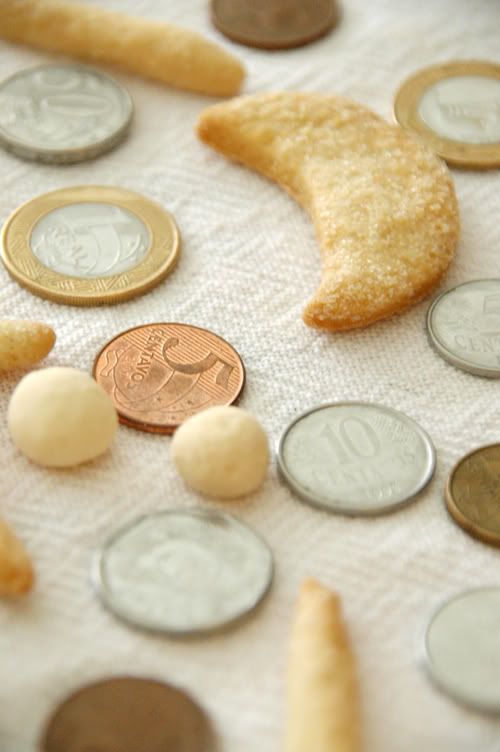
So what of this food then. The topic: biscuits and banana leaves. biscuits? yes. my eyes widened as bag upon bag of biscuits all pretty, pale, and sparkling emergered one after the other. and these are all gluten free? Alongside the biscuits were other Bahian traditional goodies; little coconut cakes, pressed sugarcane candy in a banana leaf--gold mine. Eager to try everything--at the same time--i was confused slightly by how a few of those present reached for nothing. You see, H explained to me in front of everyone under the guise of our secret language, they look down on Bahia, to them this would be like someone in the US bringing back a whole bunch of junk from Mexico. hmmm...really? well, all i can say is--sucks to be them.
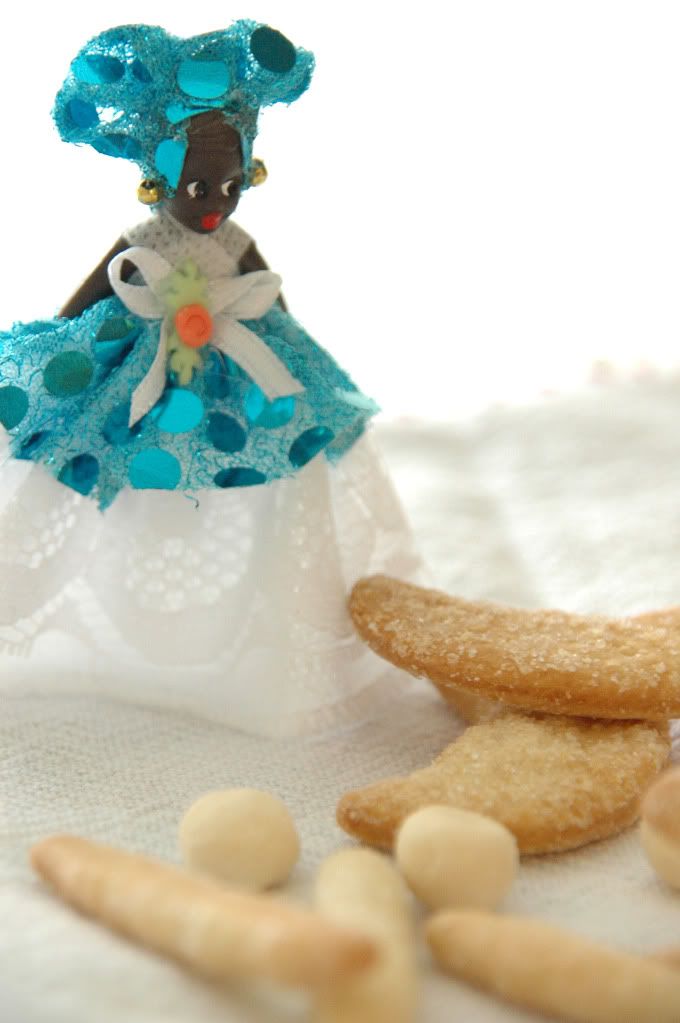
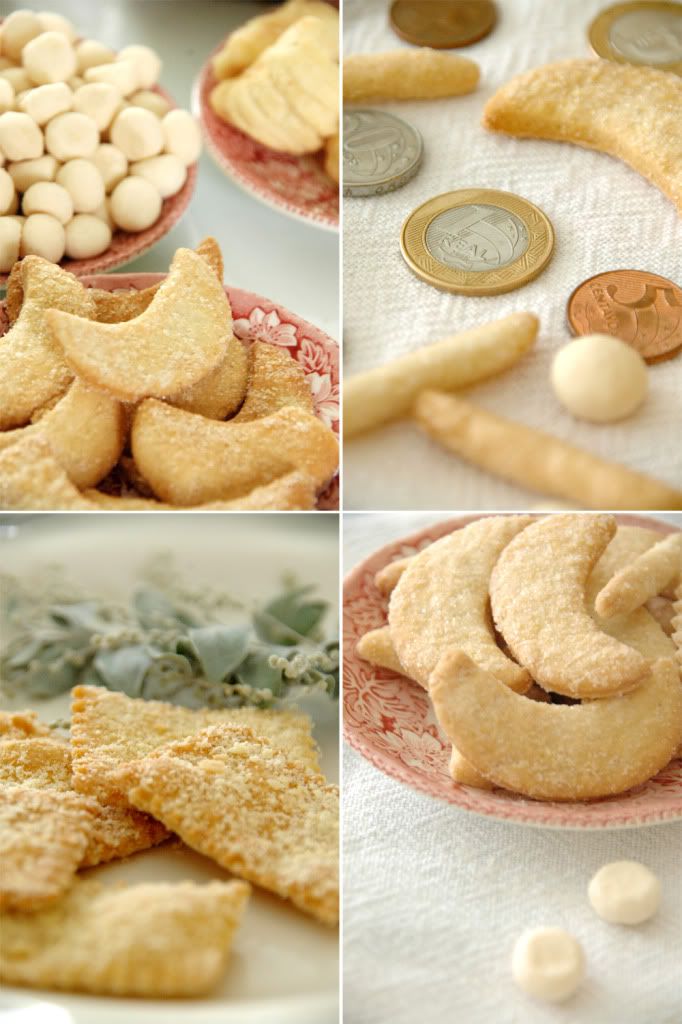
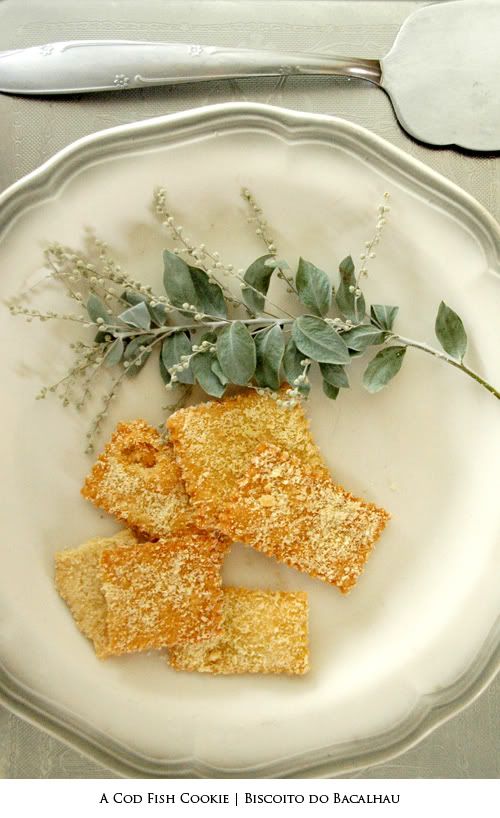
All of the biscuits, though they tasted like almond, were made from flour of mandioca root; aka tapioca. Mandioca, manioc, polvinho, goma, puma--it all come from the same root, a magical "everything begins here" tuber that i have come to adore. my next novel: I fell in Love with a Manioc, (July 2012.) Crescents, pills, sticks, twists, salty, sweet--you can make anything from mandioca. And what have we here...aqui, isso é do bacalhau. excuse me? bacalhau? Cod fish Cookies? are you for serious? Truth: they taste like a less-dried out version of nabisco chicken in a biscuit; aiater R you would be very pleased with these.
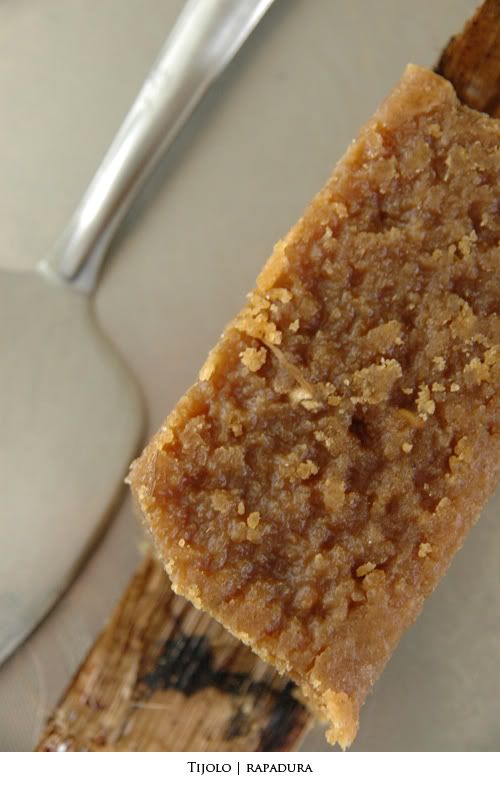
Aside from the never ending stream of pale-faced biscuits that appeared from Felix's bag; there appeared alongside a plethora of Bahian cheeses and some sweet candies, among them rapadura. Technically known as tijolo, the Portuguese word for brick, because it is usually made into a solid brick form that is fairly preserved and durable. Pretty much it is a hunk of pure sugarcane juice with spices such as cinnamon and a LOT of ginger, nuts, and even fruits. Hmmm, i thought as i racked my brain to try and communicate what i was tasting, para mim, euuuh, isso é um sabore de natal. gingimbre é muito natal. mmmm. You can find out more about rapadurahereor at more my levelhere. Rapadura first appeared in the 18th century by slaves who worked on the sugarcane plantations; high in minerals and other things that seem to give one energy, it was a crucial part of the diet as it preserved well and could last for long periods of time. according to H, this is the food that has and always will keep people from starving. For its history, the candy is commonly considered comida de pobre, food for the poor (yes i translated that myself).
As i thought of what H had said about Bahia being considered lower class it all made sense; there is much prejudice to be found anywhere, i began to think; perhaps that is how i would act if someone unloaded on my dining room table a bag of grits and collards brought back fresh from Mississippi, blech, i would think, southern food. I am not sure where this prejudice came from, i have no aversion to the culture of the southern states of the US, on the contrary i have never even experienced them, but somehow, somewhere along the way, the image and notion was planted, there is a sense in the back of my mind that connects such types of food as poor food, as country food, as lower class food. Food is as much a marker of social status and class boundary as anything; we have to be careful to not allow that to get in the way of our taste buds, else you may find yourself in regret for having missed out on something intrinsically delightful. It is impossible to control ingrained thoughts, but it is what you do with them that matters.
When I sat down to "talk out" what all these edibles were with D, she mentioned how the day happened to be Bahian independence day. what? it's its own country now? When Brasil broke from Portugal, Bahia was the last state to join the independent confederation. It is not the Brasilian independence, she continued, that is---September 7th, i cut in, i know that day. It happens to be one of my favorite days. Back to the subject--Brasilian Independence was declared on September 7th 1822, though a pocket of elite loyalists in Bahia remained true to the Portuguese crown--hmm sounds familiar, we call them Tories, but eventually they shoved off for Canada--the loyalists somehow stood their ground in battle until finally falling to the union on 2 July 1823. Hence 2 July is Bahian independence. Huh, i responded, July seems to be a very hot-headed month for revolutions; the Americans on the 4th, les Francaises on the 14th, and the Bahians on the 2nd. AND the most important of all--the Canadians on the 1st. Well. A triangle quadrangle connection of my three four favorite countries. how presh. So happy birthday Bahia, happy birthday US of A, happy birthday O Canada, and while we're at it--vive la France!
Biscuits, Bahia, Independence, family--life doesn't suck. And with a biscuit made out of cod, a weekend visiting friends and family on the back of a red motorcycle, getting lost in the neighboring city of Sorocaba on the way to another festa julhina, a backyard barbecue for little brothers entire English class, and night time riding with old jazz music--life definitely does not suck. oh did i mention the cod cookie?